
Research Interests
- Power system modeling
- Power system computational analysis
- Synthetic power grids and datasets
- Extreme event impacts on power systems
- Dynamics and stability of power systems
- Power system visualization
Selected Projects
| CAREER: Spatial Complex Network Analysis of Bulk Electric Grids for Long-Term System Planning (2025-2030)
|
| DOE SCIDAC Partnerships in Electricity: Next Generation Grid Simulation (2025-2028)
In this project we are collaborating with Oak Ridge National Lab (ORNL), Lawrence Livermore National Lab (LLNL), the National Renewable Energy Laboratory (NREL), and Virginia Tech.
|
Enhanced Geomagnetic Disturbance Modeling (2021-2026)
This project is is funded by the U.S. DOE Office of Cybersecurity, Energy Security, and Emergency Response (CESER). Collaborators include Pacific Northwest National Lab (PNNL) and the Electric Power Research Institute (EPRI). |
| High-Altitude Electromagnetic Pulse (HEMP) Transmission Consequence Model (2021-2025)
This project is funded by the U.S. DOE Office of Cybersecurity, Energy Security, and Emergency Response (CESER). Collaborators include Sandia National Lab (SNL), Los Alamos National Lab (LANL), Western Area power Administration (WAPA), Air Force Research Laboratory (AFRL), and PNM Resources. |
Performance-based Energy Resource Feedback, Optimization, and Risk Management (PERFORM) (2021-2023)
This project is funded by ARPA-E, and involves the application of synthetic electric grid datasets to grid optimization and risk management. |
| Grid Optimization Competition (GOComp) (2015-2024)
This project is funded by ARPA-E, and involves the application of synthetic electric grid datasets to testing and evaluating improved algorithms for large-scale grid optimization.
|

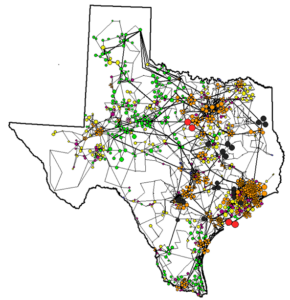 This project aims to address computational and modeling challenges inherent in the design of large-scale electric transmission networks with large numbers of inverter-based resources like wind, solar, and batteries. As increased electrification and the interconnection of renewables will require a major expansion of the electric transmission grid in the near future, this project seeks to bring transformative change to power system planning with solutions to more intelligently select new transmission line projects for grid expansion.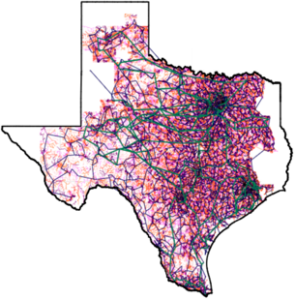

Other Research Highlights/Resources
Geomagnetically Induced Currents. Low-frequency geomagnetically-induced currents (GIC) on the electric grid can be induced by rare geomagnetic events, and may impact electric grid infrastructure reliability and operations. Along with PowerWorld Corporation, we developed the binary three-dimensional (B3D) file format to hold electric field data for GIC and other studies. See documentation here. Tools in Python and Matlab to read and write the B3D format are available on Github.